
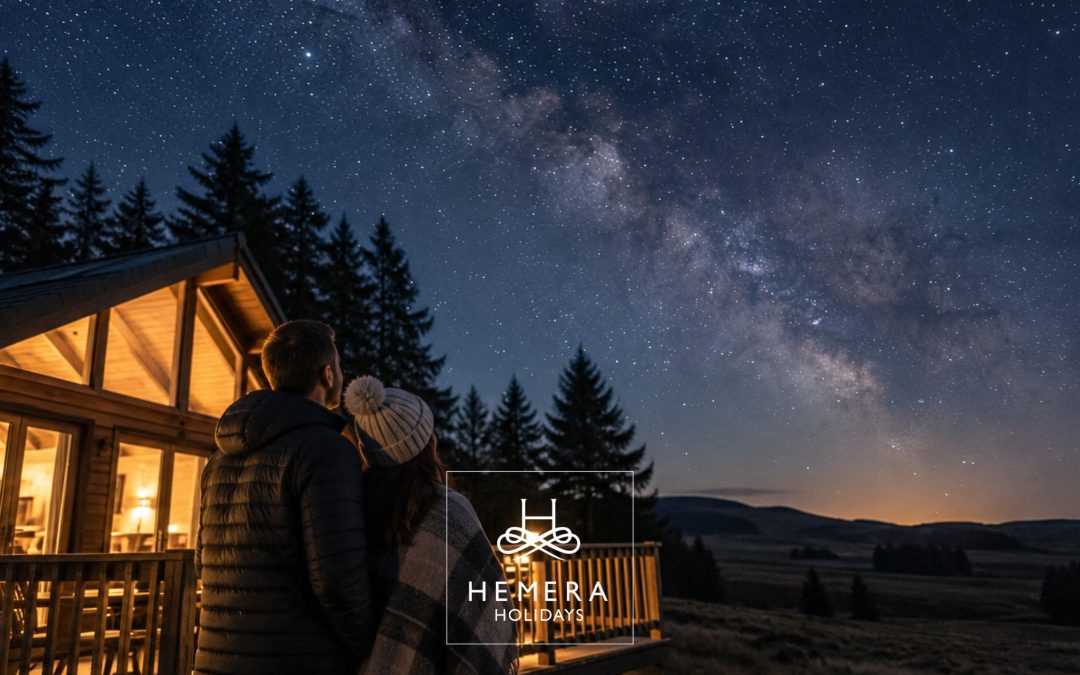
Stargazing for beginners needs no equipment and no experience. A dark sky, a clear night, and twenty quiet minutes for your eyes to adjust will show you more than most people expect to see in a lifetime of looking up. Northumberland makes it easier than nearly anywhere in England, because it holds some of the darkest skies in the country, and what hangs overhead shifts through the year: bright winter constellations on a frosty night, the Milky Way arching over in late summer, your own breath clouding while the stars come out one by one.
Here is what a beginner can pick out season by season, when the skies turn their darkest, and the handful of small things that make all the difference on a clear night.
What a beginner needs to start (less than you’d think)
The lovely thing about a first night under the stars is how little it asks of you. A telescope can wait, on your first few nights it would only slow you down. Start with this:
- Warm clothes and a flask. You stand still in the cold, so dress as you would for a winter beach walk, even in summer.
- A red torch, or your phone screen set to red. White light wipes out your night vision in a second; red light leaves it intact.
- A little patience. Full dark adaption takes around twenty minutes, so stay off the bright phone screen and let your eyes do their slow work.
- A free star app, used sparingly. Handy for naming what you find, best switched to night mode.
That is enough for the Milky Way, the brighter constellations, the craters on the Moon through any cheap binoculars, and the odd shooting star to make someone gasp.
What you can see with the naked eye
You can see a surprising amount with nothing but your eyes. On a clear, moonless night under a dark Northumberland sky, you can pick out several thousand stars, far more than the few dozen a town garden ever shows.
Start with the easy wins. The Moon is the obvious one, its craters and shadows shifting with every phase. The bright points that hold steady and never twinkle are usually planets: Venus blazing low after sunset, Jupiter steady and white, Mars a faint orange. Stars twinkle and planets hold steady, which is the quickest way to tell them apart.
Then look for the Milky Way, a soft luminous band on the darkest nights, and the faint smudge of the Andromeda Galaxy, the most distant thing visible to the naked eye at around 2.5 million light years away. Picking it out is a proper first-night triumph.
Your first kit: binoculars before a telescope
When you are ready for more, reach for binoculars before a telescope. The astronomer Patrick Moore spent years telling beginners the same thing, and NASA says it too: for many stargazers a good pair of binoculars is the better first instrument, easy to use and far more forgiving than a telescope you have to aim and align.
A modest pair, anything from 7×35 to 10×50, changes what you can see. The Moon’s craters sharpen, the Pleiades open from a smudge into a cluster of blue-white stars, and the band of the Milky Way breaks into countless points of light. They cost a fraction of a telescope, weigh next to nothing in a coat pocket, and work the moment you lift them.
Learn the sky with your eyes and a pair of binoculars first. A telescope makes far more sense once you already know your way around.
What you can see in Northumberland by season
The whole sky turns through the year, so the same dark field gives you a different show in January than it does in July. This is what to look for, and when.
| Season | Look for | Best for |
|---|---|---|
| Spring (Mar to May) | The Plough high overhead, Leo, and the bright orange star Arcturus rising in the east | Easy first constellations on milder nights |
| Summer (Jun to Aug) | The Summer Triangle, the Milky Way low in the south, the Perseid meteors in August | The Milky Way and meteor showers, though nights are short |
| Autumn (Sep to Nov) | The Milky Way high overhead, the faint smudge of the Andromeda Galaxy, the Square of Pegasus | Dark skies returning at comfortable evening hours |
| Winter (Dec to Feb) | Orion, the Pleiades, brilliant Sirius, the winter Milky Way, and the aurora on active nights | The brightest, richest sky for a beginner |
Autumn and winter are the prize. The dark lasts for longer, the air runs clear and crisp, and the most recognisable stars are all out at once. The catch is the cold, which is exactly where a warm base earns its keep at the end of the night.
A meteor-shower calendar for the year
Meteor showers are the easiest event for a beginner: no kit, just a dark sky, a clear night and a little patience. These are the ones worth staying up for in Northumberland. Peak nights shift by a day or two each year, so check nearer the time, and the darkest hours after midnight, well away from moonlight, are always best.
| Shower | Peak nights | What to expect |
|---|---|---|
| Quadrantids | Around 3 to 4 January | A sharp, brief peak; up to 40 an hour under a clear, dark sky |
| Lyrids | Around 22 to 23 April | Fast, bright meteors; a modest but reliable spring shower |
| Perseids | Around 12 to 13 August | The summer favourite, up to 50 to 100 an hour, though short nights limit the dark window |
| Orionids | Around 21 to 22 October | Swift meteors from the dust of Halley’s Comet; a quieter autumn show |
| Leonids | Around 17 to 18 November | Fast meteors with the odd bright fireball |
| Geminids | Around 13 to 14 December | The richest and most reliable of the year, up to 120 an hour on a dark night |
When and where the skies are darkest
Three things decide how much you see: the Moon, the weather, and how far you sit from town lights. Aim for a clear night within a few days of a new moon, when the sky runs blackest, and give the forecast a proper read before you commit the evening. If you want to see how dark your patch of sky really is, a UK light pollution map shows you at a glance.
For darkness, Northumberland stands almost alone. The county holds the Northumberland International Dark Sky Park, designated in 2013 as England’s first, covering the National Park and much of Kielder. If you fancy the experience with an expert and a serious telescope, the Kielder Observatory runs guided evenings through the year, and they book up fast, so plan ahead.
You needn’t drive that far inland to be rewarded, though. Rural Northumberland away from the towns gives a beginner plenty to look at on any clear, moonless night.
Stargazing from the lodges
The simplest stargazing of all is the kind you do from your own doorstep, with the kettle a few steps behind you. The lodges sit deep in dark, rural countryside, well clear of city glow, so on a clear night you step outside, look up, and there it is. For the cold months, when the sky is at its best, a lodge with a hot tub lets you watch Orion climb with the steam rising around you and your toes perfectly warm. A frosty winter walk by day and the stars by night make a hard season feel like the best one to visit.
A few tips for your first clear night
Begin with something you can find for certain, the Plough in summer or Orion in winter, then use it as a signpost to everything around it. Give your eyes time before you judge how much is up there, because the sky keeps filling in as the minutes pass. And don’t hold out for a perfect night. A partly clear sky still hands you the brightest stars, and the surest way to learn your way around is simply to keep stepping outside and looking up.
Start under Northumberland’s dark skies
Stargazing for beginners comes down to a dark sky, a clear night, and a little patience, and Northumberland supplies the first of those better than almost anywhere in England. Pick your season, keep an eye on the Moon and the forecast, wrap up warm, and let your eyes do the rest.
To plan a trip around the darkest months, read our stargazing in Northumberland guide, or browse the lodges at Percy Wood Country Park and Felmoor Park for a dark-sky base with a hot tub to sink into when the cold bites.